
Where Haskell County Warrant Records Live
No official Haskell County Sheriff website publishes a live active-warrant list. That gap is the most important fact for anyone starting a search. Warrants in the county are signed by a judge and entered into a court case file, so the records show up in the court docket long before they appear anywhere else. The two practical online channels are the Oklahoma State Courts Network, known as OSCN, and On Demand Court Records, known as ODCR. Both carry Haskell County District Court cases, and warrant activity often appears as a docket entry inside a criminal or traffic case.
District judges and the Haskell County associate district judge issue most warrants in felony, misdemeanor, civil, and traffic matters. The Stigler municipal judge issues warrants for city ordinance and municipal traffic cases. After an arrest is made on a warrant, custody status moves to statewide tools such as Oklahoma VINE and the Oklahoma Department of Corrections, not to a county roster. Because no single page lists every open order, confirming a warrant usually takes a docket search plus a phone call to the office that holds the case.
The Oklahoma Sheriffs' Association listing for Haskell County names Terry Garland as the county sheriff but does not post a searchable warrant list or a most-wanted page.
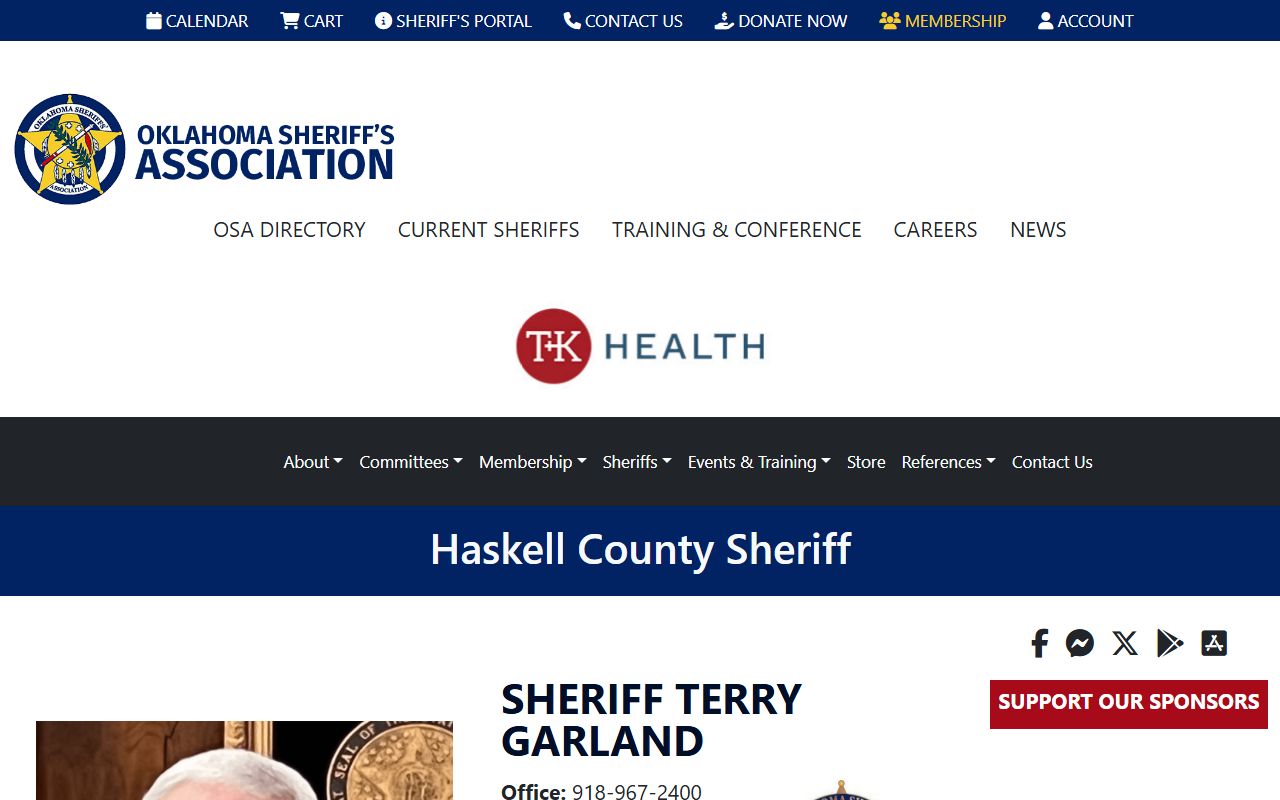
That listing confirms who runs the sheriff's office, which matters when you call to ask whether an arrest warrant or hold is active, since the office itself is the only source for that status.
Types of Warrants in Haskell County
Warrants are not all the same, and the type controls how you resolve it. Some come from a new criminal charge, while others come from something that happened after a case was already open, such as a missed hearing or an unpaid fine. The categories below cover the orders most often seen in Haskell County District Court and the Stigler Municipal Court.
- Arrest warrant - Issued after a judge finds probable cause or charges are filed, and it authorizes police to arrest the named person.
- Bench warrant - Issued by a judge for a failure to appear, a failure to pay, a probation violation, or contempt of court.
- Search warrant - Authorizes a search or seizure at a stated place, and it may be sealed for a time while an investigation continues.
- Capias or capias pro fine - A court order directing arrest or appearance, often tied to nonappearance or unpaid fines and costs.
- Fugitive warrant or hold - Covers an out-of-county, out-of-state, or corrections-related hold placed on a person already in custody.
How to Search Haskell County Warrants
Because there is no sheriff warrant portal, the search runs through the court record. ODCR lets the public search Haskell County dockets for free and adds an outstanding-warrant filter inside its paid advanced plan. OSCN provides the official state network view of the same district court. When the online docket is unclear, the Court Clerk and the Stigler Municipal Court answer by phone, and the sheriff's office handles arrest-warrant and hold questions directly.
- Open ODCR at odcr.com, choose Court "Haskell," and search by party name in last-name, first-name order, or select the case type "Search Warrants."
- For court-filed bench and arrest warrants, review the docket entries inside a person's criminal or traffic case; the $5 monthly advanced plan adds an outstanding-warrant filter.
- Cross-check the official record at OSCN using the Haskell County District Court selection and the case number; complete any Turnstile verification the site shows.
- Call the Court Clerk at (918) 967-3323 with a name or case number to ask whether a warrant in the court file is still active.
- For an arrest warrant or jail hold, contact the Haskell County Sheriff's Office, or submit an open-records request to the sheriff for warrant and booking information.
- For a city citation or municipal failure to appear, call the Stigler Municipal Court at (918) 967-2164, since municipal warrants do not appear in the district court docket.
Haskell County Warrant Lookup Channels
No two channels cover the same ground, so it helps to match the warrant to the office that holds it. The table below maps each public channel to what it covers and where it falls short. District court warrants show in ODCR and OSCN, while municipal warrants and live arrest-warrant status sit with the city court and the sheriff.
| Channel | How to Search | What It Covers | Limitations |
|---|---|---|---|
| ODCR | Court Haskell; party name; case type Search Warrants; advanced outstanding-warrant filter | Court-filed warrants and docket entries | Advanced warrant filter is paid; sealed warrants may not show |
| OSCN | Haskell County District Court; case number or name | Official district court dockets | Turnstile check may appear; not a live sheriff list |
| Court Clerk | Phone or in person with name or case number | Bench and case warrants in the court file | Clerk cannot give legal advice or guarantee status |
| Sheriff / Jail | Phone or open-records request | Active arrest warrants, holds, booking | No official online list located |
| Stigler Municipal Court | Citation or defendant details through the municipal court | Municipal traffic and city warrants | Separate from the district court |
Note: A warrant can sit in more than one system at once, so a clean district court docket does not rule out a separate municipal or out-of-county order.
What a Haskell County Warrant Record Shows
When a warrant appears in a court docket or is confirmed by the clerk, it carries a standard set of details. These fields tell you who the order names, why it was issued, and whether it is still open. Bond information and sealed status are the fields people check most often.
| Field | What It Shows |
|---|---|
| Person Named | Defendant or subject of the warrant |
| Case or Warrant Number | Court case number or warrant number when public |
| Issuing Court | Haskell County District Court, Stigler Municipal Court, or another court |
| Charge or Reason | Offense or the reason the warrant was issued, such as failure to appear |
| Date Issued | Date the judge signed the order |
| Bond | Bond amount or a no-bond notation when public |
| Status | Active, recalled, served, quashed, cleared, or sealed |
| Related Date | Linked court date or payment-plan reference |
Custody Status After a Warrant Arrest
Once a person is arrested on a Haskell County warrant, the question shifts from the warrant to custody. Oklahoma runs two statewide tools that fill the gap left by the missing county roster. VINE tracks custody status and lets the public register for notifications, and the Department of Corrections lists offenders who are sentenced into state custody or under state supervision. Neither is a complete pretrial county-jail roster, but together they confirm whether a person has moved into a known facility.
Oklahoma VINE is the first place to check after an arrest. The Oklahoma VINE custody-status portal searches by person where available and registers victims and the public for status alerts.

VINE is useful when a warrant has just been served, since it can flag a custody change before any court docket is updated. For people who are already sentenced, the next tool is the state corrections lookup.
The Oklahoma Department of Corrections offender information page explains how custody transfers from a county jail to state prison and how long that can take.
The corrections lookup warns that its information is abbreviated and not a full account of the offense or sentence, so it points serious requests back to the agency for documentation. A look at the underlying charges, bond, and court dates is still best handled in the Haskell County criminal court records.
How to Resolve an Outstanding Warrant
An open warrant does not go away on its own, and ignoring it usually adds cost or a new arrest. The steps below follow the order that works best in a rural Oklahoma county where the issuing court, not a website, controls the outcome. Start by pinning down which court signed the order, because a district court warrant and a municipal warrant are cleared in different places.
- Identify the issuing court: Haskell County District Court, Stigler Municipal Court, another Oklahoma county, a tribal court, or an out-of-state court.
- Call the Court Clerk or the municipal court with the case or citation number and ask whether the warrant is active and whether a court date, bond, or payment can resolve it.
- If the warrant is tied to a criminal case, speak with an attorney before appearing whenever possible.
- Do not rely on a paid background-check site for warrant status; use the court or the sheriff.
- If you plan to surrender, ask where to report, whether bond can be posted, and which payment methods are accepted.
- After the matter is handled, confirm the docket shows the warrant recalled, quashed, served, or cleared so stale information does not linger.
Important: Talk with a lawyer before you turn yourself in on a felony or any case with possible jail time, since how and when you appear can affect bond and the outcome.
Restricted Haskell County Warrant Records
Not every warrant is open to the public. Some are sealed by law, and others are hidden because the underlying case is confidential. A search that returns nothing does not always mean no order exists.
Search warrants can be sealed while an investigation is active, and a sealed search warrant or sealed indictment may stay nonpublic until a judge unseals it. Juvenile and youthful-offender matters are restricted, so a warrant connected to a juvenile case will not appear as an ordinary public record. Expunged cases are sealed from public access under Oklahoma law, which can remove related warrant entries from the docket view. Federal warrants are another separate track, since cases arising in Haskell County that fall under federal jurisdiction are handled through the United States District Court for the Eastern District of Oklahoma rather than the county court. When a record is restricted, the Court Clerk and the issuing court remain the only authority on whether an order exists and what its current status is.