
What Is a Haskell County Court Docket
A docket is the official register of a court case. It records each event in date order: the first filing, the summons or warrant, every motion, each hearing, the orders a judge signs, and the final outcome. Think of it as the spine of the case. The docket does not hold the full text of every document, but it lists each one and shows when it was filed and what the court did next.
That makes a docket different from the full case file. The docket is the index and timeline. The full file holds the actual pleadings, exhibits, signed orders, and the judgment itself. Most Haskell County dockets are public and can be read online for free, while the underlying documents may sit only at the clerk's counter or behind a paid image plan.
In Haskell County, nearly all of these dockets belong to the District Court at the courthouse in Stigler. The District Court is the trial court of general jurisdiction, so its dockets cover felonies, misdemeanors, civil suits, family and divorce cases, probate, small claims, protective orders, and traffic citations filed in District Court. City ordinance cases are the main exception, since those run on a separate municipal docket.
Daily Dockets and District Court Reports
Oklahoma posts Haskell County dockets through two online systems. The Oklahoma State Courts Network, called OSCN, is the official statewide docket service. On Demand Court Records, called ODCR, is a portal that many Oklahoma counties use, and Haskell appears on its court list. The OSCN docket landing page also carries a set of District Court Reports that pull together the day's activity rather than a single case.
These reports help when you want to see the whole calendar instead of one defendant or one plaintiff. They group cases by the day a court acts, by the judge hearing them, and by the type of event. The list below names the District Court Reports that OSCN links from its docket page.
- Civil cases with trial dispositions, showing how civil matters were decided at trial.
- Daily dockets organized by judge, so you can see one judge's calendar for a day.
- Daily dockets organized by case type, grouping criminal, civil, family, and other matters.
- Daily dockets organized by event, listing hearings, arraignments, and motions set for a date.
- Daily filings reported by county, showing the new cases opened in Haskell County.
The same landing page links out to the OSCN docket search, the case number lookup, and a Search Non-OSCN Counties link that routes to ODCR. You can reach the official starting point at the Oklahoma State Courts Network docket portal, which is the first stop for a Haskell County docket search.
Searching Dockets by Case Number or Party Name
There are two ways into a Haskell County docket: the case number and the party name. The case number is the fastest because it points to one file. A Haskell number is built from a prefix, a year, and a sequence, such as CF-2014-1. The prefix tells you the case type. Common Haskell prefixes are CF for a felony, CM for a misdemeanor, PB for probate, FD for a family or divorce case, SC for small claims, TR for traffic, and SW for a search warrant.
When you do not have a number, search by name instead. Both systems take a party name entered as last name, first name. ODCR adds extra filters so you can narrow a common name by party type, case type, filing date range, or activity date. The steps below walk through a docket lookup from either starting point.
- Open the OSCN docket portal or odcr.com and choose name search or the case number lookup form.
- Select Haskell County District Court on OSCN, or pick Haskell as the court on ODCR.
- Type the case number in the format shown, such as CF-2014-1, or enter a party name as Last, First.
- On ODCR, narrow the results by party type, case type, full case number, or a filed date range if the name is common.
- Open the matching docket and read the entries from the top down in date order.
- If OSCN shows a human-verification screen, complete it; the site uses it to block automated traffic and may limit access until you do.
Searching and viewing docket information is free on both systems. Only ODCR's advanced filters and its scanned document images carry a charge, so the basic name or case number lookup never costs anything.
Reading a Haskell County Docket Entry
A docket sheet packs a lot into a compact layout. Across the top sit the identifiers for the case, then the parties and the judge, and below them the chronological list of events with the money and the outcome. The table maps the fields you are most likely to read on a Haskell County docket pulled through OSCN or ODCR, even when scanned copies of the documents are not posted.
| Field | What It Shows |
|---|---|
| Case Number | The prefix, year, and sequence that identify the file, such as CF-2025-00001. |
| County and Court | The court that holds the case, here the Haskell County District Court. |
| Case Type | Felony, misdemeanor, civil, family, probate, small claims, traffic, or search warrant. |
| Filing Date | The day the information, petition, ticket, or probate filing reached the clerk. |
| Parties and Roles | State of Oklahoma versus a defendant, or plaintiff and defendant, petitioner and respondent. |
| Attorneys and Judge | The district attorney, private or appointed counsel, and the assigned judge. |
| Docket Events | Minute entries in date order: warrant issued, bond set, arraignment, plea, motion, order, continuance. |
| Charges or Cause | Offense name, count, and statute in criminal cases, or the civil cause and probate category. |
| Hearing Dates | The date, time, and type of each setting, with the courtroom or judge when listed. |
| Financial Assessments | Fines, court costs, clerk and administrative fees, CLEET and forensic assessments, restitution, and payment plans. |
| Disposition and Status | Open, pending, disposed, dismissed, convicted, deferred, sealed, or appealed. |
Docket events on Oklahoma case sheets carry recognizable labels. Lines such as Judgment and Sentence, Amended Payment Plan Agreement, Court Clerk Administrative Fee, sheriff service fee, continuance, and order appear again and again across criminal files. Personal identifiers, sealed matters, juvenile records, and expunged cases may be withheld or redacted even when the rest of the docket is open.
Reading Dispositions and Status Lines
The disposition is the part of the docket most people came to read. It tells you where the case stands or how it ended. A single docket can carry several disposition entries, one per count or claim, so a file with three charges might show a plea on one and a dismissal on another. Read the dates carefully, because the most recent entry usually controls the current status.
The terms below show up often on Haskell County dockets. Each one is defined in plain language so a status line is easy to follow.
- Disposed
- The case or count has been resolved and the court has entered an outcome.
- Dismissed
- The charge or claim was dropped, by the prosecutor, the parties, or the judge.
- Deferred sentence
- Sentencing is delayed and the case may be dismissed if the defendant completes set conditions.
- Judgment and Sentence
- The court entered a conviction and imposed the penalty in a criminal case.
- Continuance
- A hearing or deadline was moved to a later date, so the case stays open.
- Bench warrant
- A judge ordered an arrest, often after a failure to appear or to pay.
A docket that ends on an open or pending line is still active. One that ends on a dismissal, an acquittal, or a satisfied judgment is closed. When a status looks unclear, the safest read is the last dated entry, not the case caption at the top.
ODCR Update Status and Coverage Dates
Timing matters when you rely on an online docket. A hearing set this morning is useful only if the portal already shows it. ODCR keeps a public status page for each Oklahoma court, and the Haskell County entry lists the local Court Official, the coverage start date, and how often new activity is loaded.
For Haskell County, that status page reports records going back to October 27, 1997, with updates processed hourly, and it showed the county up to date at inspection. The hourly cycle means a same-day filing or a new hearing usually appears within the day rather than after a long delay.
The ODCR court status list is published at the ODCR court update status page, where Haskell appears alongside its update timing and coverage start.
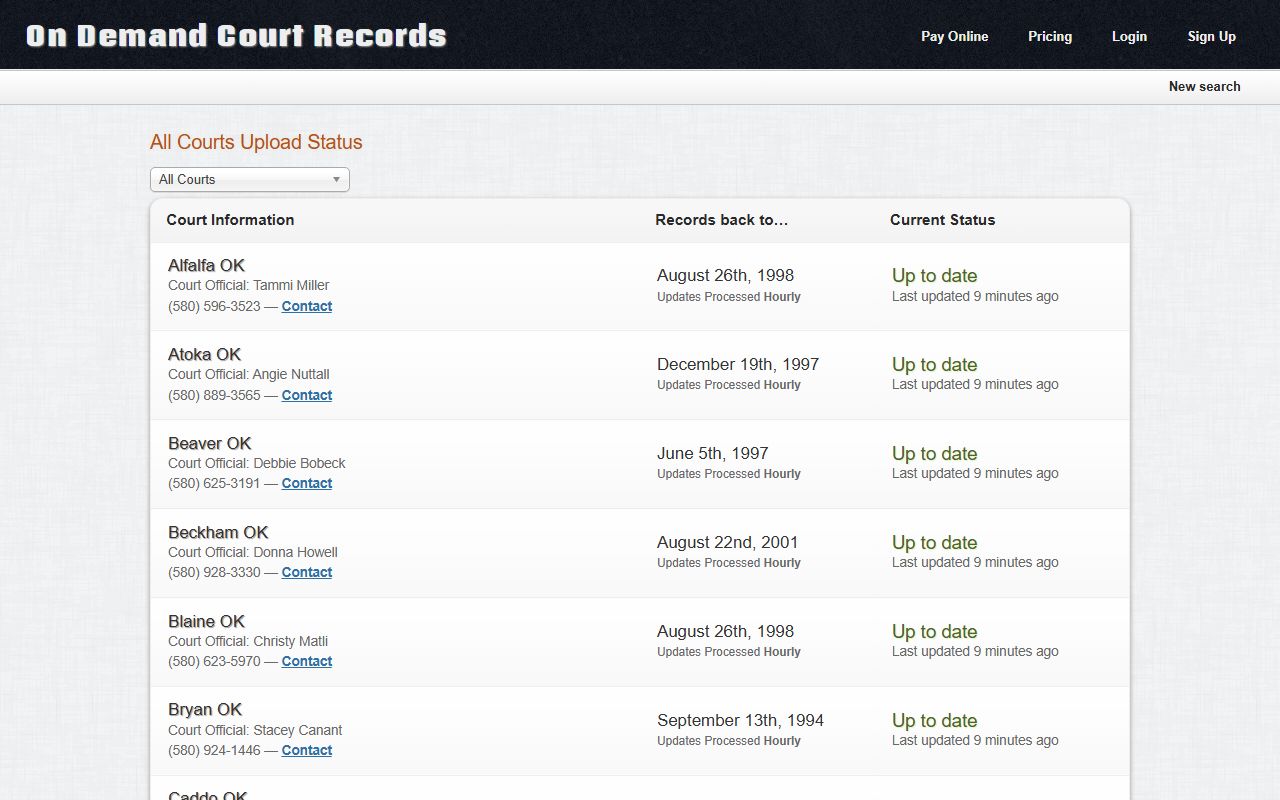
That status view confirms how current the Haskell County court dockets are before you trust a result, which is helpful when a recent filing has not yet shown up on a name search.
Note: ODCR coverage for Haskell County begins October 27, 1997, so any docket filed before that date may exist only in the Court Clerk's paper files.
Federal Court Dockets for Haskell County
Not every case tied to Haskell County sits in the state District Court. Federal crimes, federal civil-rights suits, federal-question and diversity cases, and bankruptcy filings run through the federal courts instead. Haskell County falls in the U.S. District Court for the Eastern District of Oklahoma, which sits in Muskogee rather than Stigler. Federal dockets are kept in a separate system and are not searched through OSCN or ODCR.
The federal docket system is PACER, short for Public Access to Court Electronic Records. PACER covers district, bankruptcy, and appellate filings nationwide, and most access requires a free registration with per-page charges for documents. You can register and search through the PACER federal case access service.
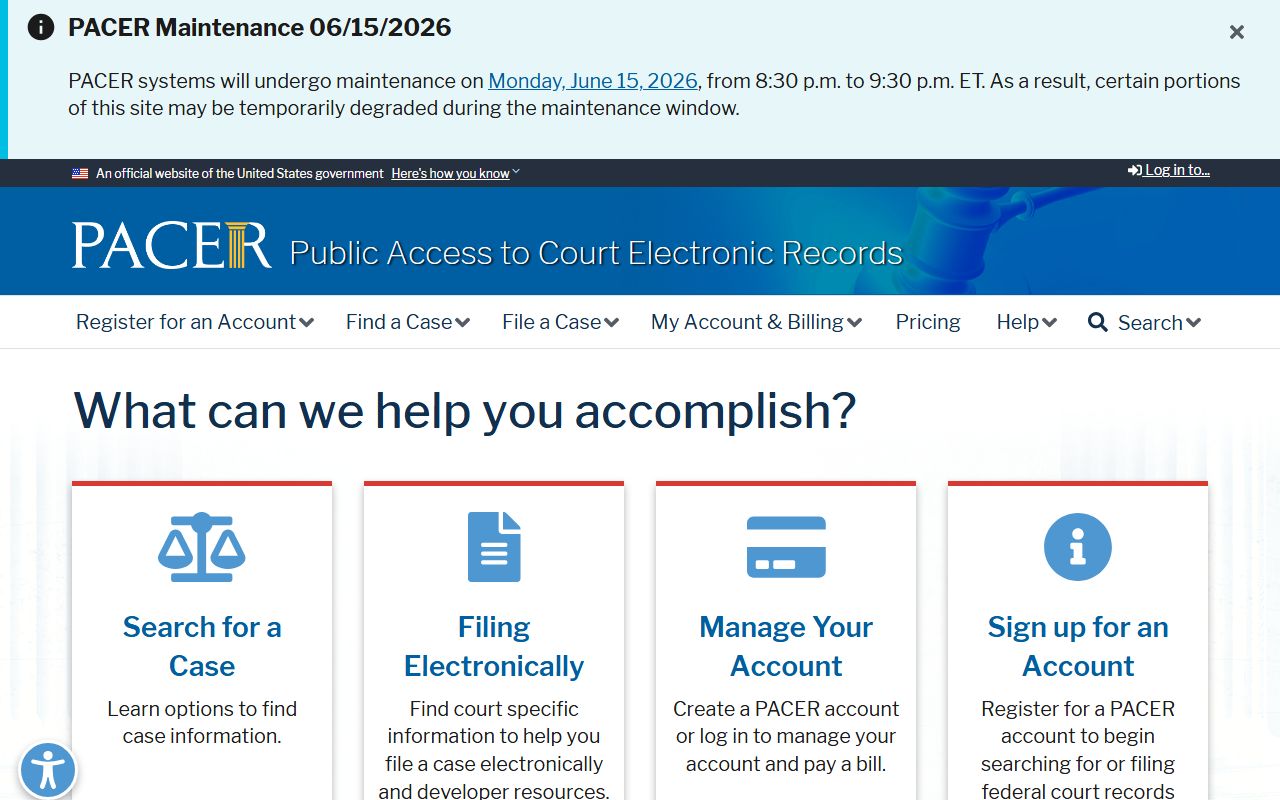
That portal is the gateway to federal dockets for any Haskell County matter that was filed in federal court rather than the state District Court.
The Eastern District also runs its own electronic filing system, called CM/ECF, where attorneys file and view documents directly. The Eastern District CM/ECF login sits at the Eastern District of Oklahoma CM/ECF site.
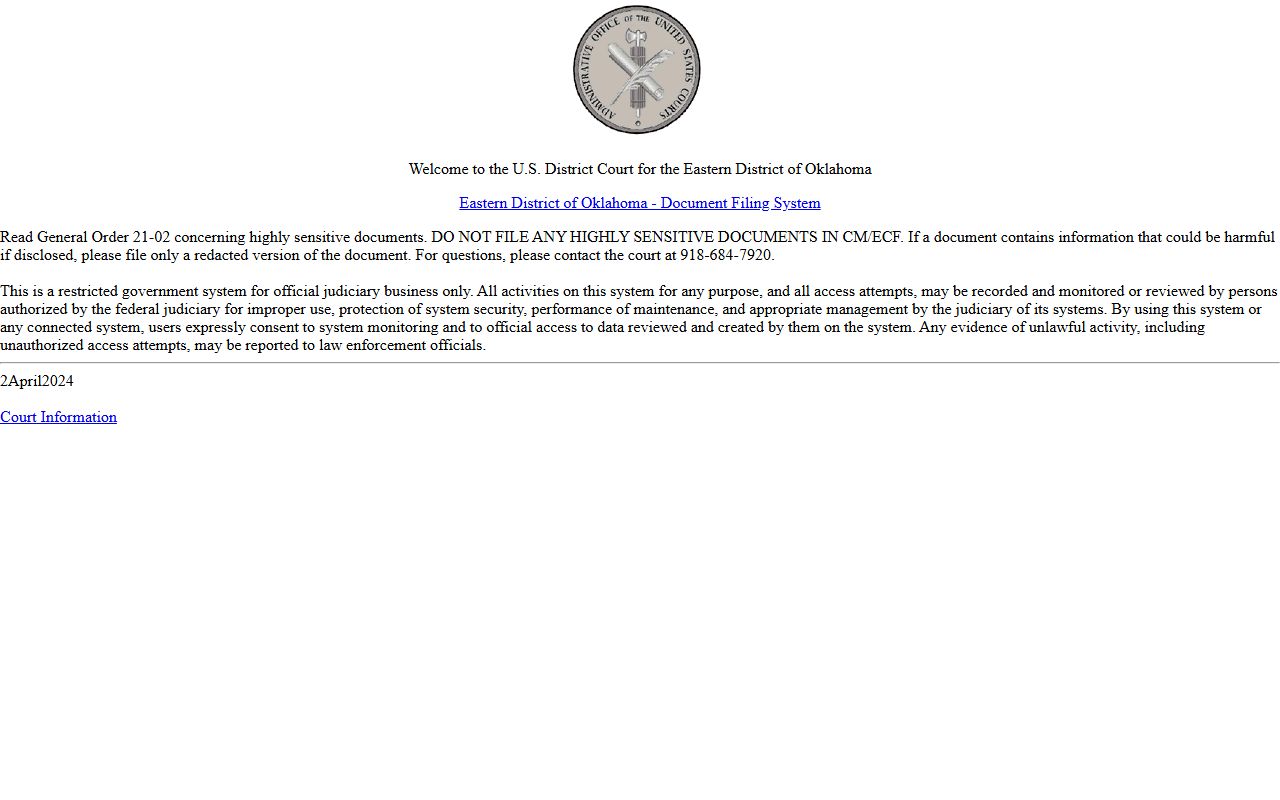
CM/ECF and PACER are the official channels for federal dockets, so a Haskell County federal case is followed there, while everything filed at the local District Court stays in OSCN and ODCR.
Docket Versus the Full Case Record
A docket and a full case record are not the same thing, and the difference decides where you look. The docket is the public timeline, easy to read and usually free online. The full record is the stack of actual documents behind each docket line, and getting certified copies often means a fee or a trip to the clerk. The comparison sets the two side by side.
| Docket | Full Case Record | |
|---|---|---|
| Format | List of dated entries and events | Full pleadings, exhibits, and signed orders |
| Access | Often online and free through OSCN or ODCR | May require a paid image plan or a clerk visit |
| Best use | Track hearings, status, and case progress | Legal review, evidence, and certified copies |
| Where it lives | Statewide online docket systems | Court Clerk's office in Stigler |
For most quick questions, the docket answers them. When you need the wording of an order, a certified judgment, or a document image that the portal does not post, the full record at the Court Clerk is the next step.
Municipal Dockets Versus District Court Dockets
Stigler runs its own municipal docket, and it does not appear in the OSCN District Court search. Municipal courts handle city ordinance matters, local traffic citations, and city-code violations. So a Stigler city ticket or a municipal failure-to-appear may never show up when you search the Haskell County District Court dockets, even though both courts sit in the same town.
That split trips up a lot of searches. If a citation cannot be found on OSCN or ODCR, it may be a municipal case rather than a District Court case. Stigler Municipal Court takes payments through an outside vendor and lists its own counter and phone for case questions.
Stigler Municipal Court
115 S. Broadway
Stigler, OK 74462
(918) 967-2164
Handles city ordinance and municipal traffic dockets
District Court traffic tickets, by contrast, do appear in OSCN and ODCR under TR numbers and may be eligible for online payment. The broader split between state and city cases is laid out on the Haskell County District Court page.
When to Call the Haskell County Court Clerk
Online dockets cover a lot, but not everything. The Court Clerk is the office to call when a record is too old for online coverage, when a docket entry is unclear, when you need a certified copy, or when a case looks sealed or missing. The clerk can confirm whether a file exists, what it holds, and how to request copies, though the office cannot give legal advice.
Court Clerk Tina Oaks leads the office at the courthouse in Stigler. A quick phone call before a special trip confirms the counter is open and the file you want is on site, since the clerk's directory lists the address and phone but not separate posted hours.
Haskell County Court Clerk
Tina Oaks, Court Clerk
202 E. Main St
Stigler, OK 74462
(918) 967-3323
Call to confirm counter hours before visiting
For files filed before late 1997, for certified copies, and for any docket that does not surface online, the clerk is the reliable next step. The office and its request channels are profiled on the Haskell County Court Clerk page.